Contact Product Manager:

Laser-to-Fiber Coupling
Introduction:
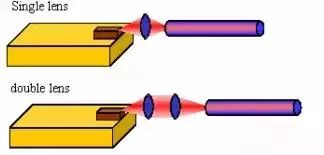
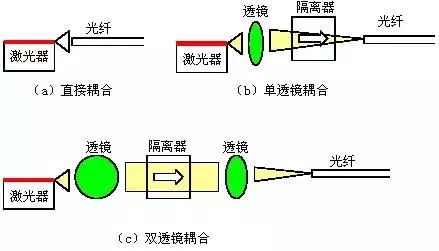
There are two main ways for the light signal from a laser to enter a fiber: direct coupling and lens coupling; lens coupling is further divided into single-lens and multi-lens coupling. Lens coupling yields higher coupling efficiency than direct coupling. With two-lens coupling, the main advantage is that tolerances can be spread out, giving the optical components more room for displacement.
Direct Coupling:
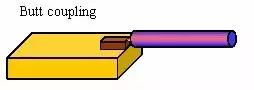
Direct coupling can be achieved with cleaved or tapered fibers. A cleaved fiber is obtained by directly cleaving a bare fiber; its end face is flat and it is relatively inexpensive, but the flat face causes high reflection, and the insertion loss when coupling with a laser is also high (typically 9-12 dB). A tapered fiber combines a lens at the fiber tip, and can be formed mainly by the following two methods: 1. Melting and pulling the fiber end into a taper; this tapers both the core and the cladding. The fiber is usually heated by an electric arc or by dipping it into molten glass. Lens symmetry can be controlled by controlling the process. This method yields an insertion loss of about 2-3 dB. 2. Etching or grinding: this forms a lens on the fiber end face while keeping the core diameter unchanged. It can also produce other profiles (such as a paraboloid) beyond a simple sphere. This method achieves better coupling efficiency, with an insertion loss as low as about 0.2-0.4 dB when coupling with a laser. For direct coupling, the fiber tip is usually mounted close to the laser, so the fiber must extend into the package. If a hermetic package is required, the fiber must also be metalized to seal it to the package. In addition, in direct coupling the main factors affecting light-source-to-fiber coupling efficiency are the source's divergence angle and the fiber's numerical aperture (NA). The size of the source emitting area, the size and shape of the fiber end face, and the distance between them also affect coupling efficiency.
Lens Coupling:
Lens coupling can use a single lens or multiple lenses. With a single lens, the distance from the laser to the fiber end face is determined by the radii of the front and rear surfaces of the lens. With multiple lenses, the beam is collimated by one lens and then focused by a second lens. When reflection must be tightly controlled, an isolator can be placed anywhere after the beam is collimated (i.e., anywhere between the two lenses). In addition, with lens coupling one of the lenses can be mounted on the package, so the fiber need not enter the package and need not be metalized.