Product Description:
- For the optics industry, suited to optical bonding on glass surfaces, metals, glass fibers and glass-filled plastics
- Suitable for biomedical use
- Recommended for bonding lenses, prisms, mirrors and terminating or splicing optical fibers in aerospace and industrial optics
- Meets the US federal MIL-A-3920 standard for optical bonding materials
- After aging, withstands -150°C to +125°C
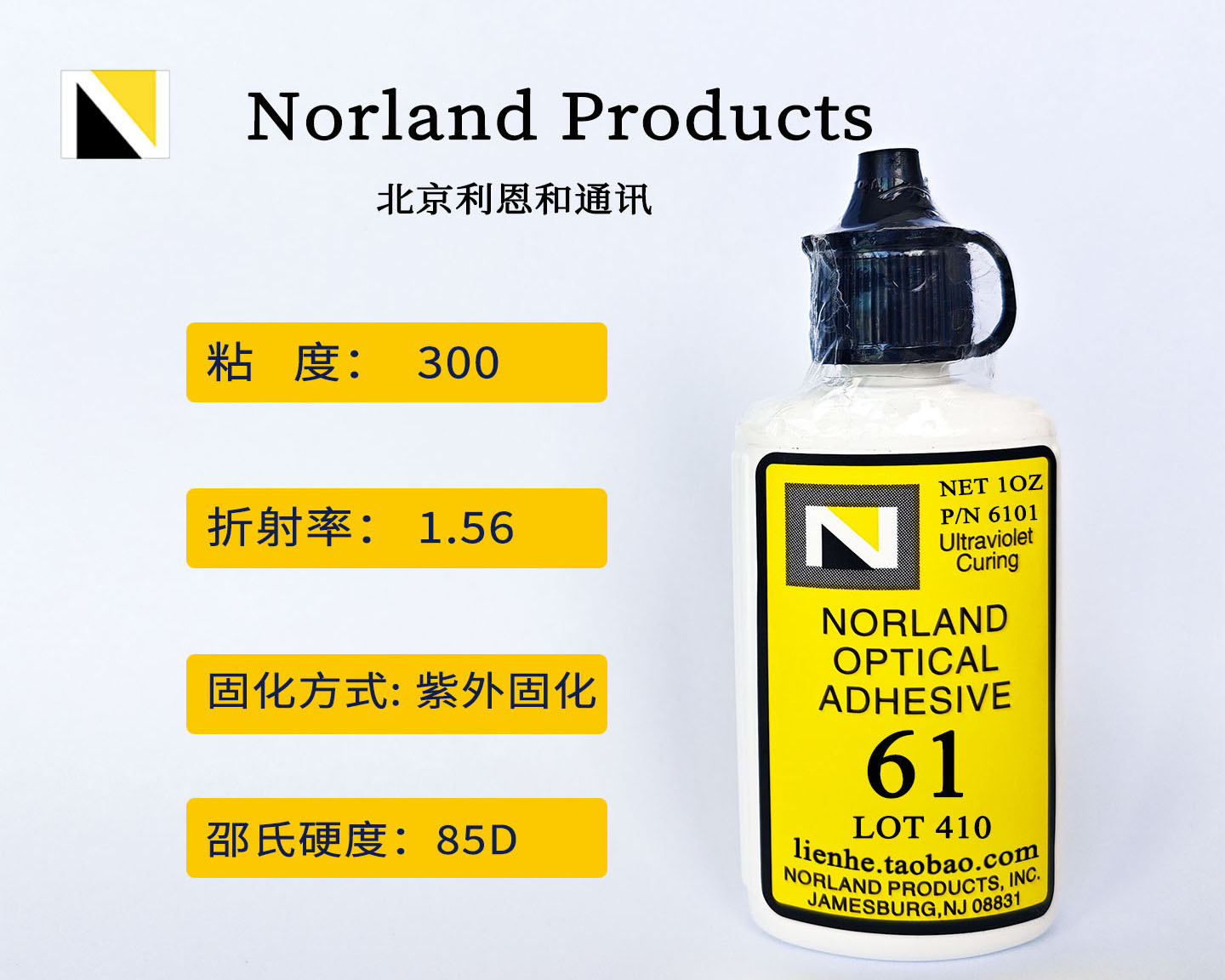
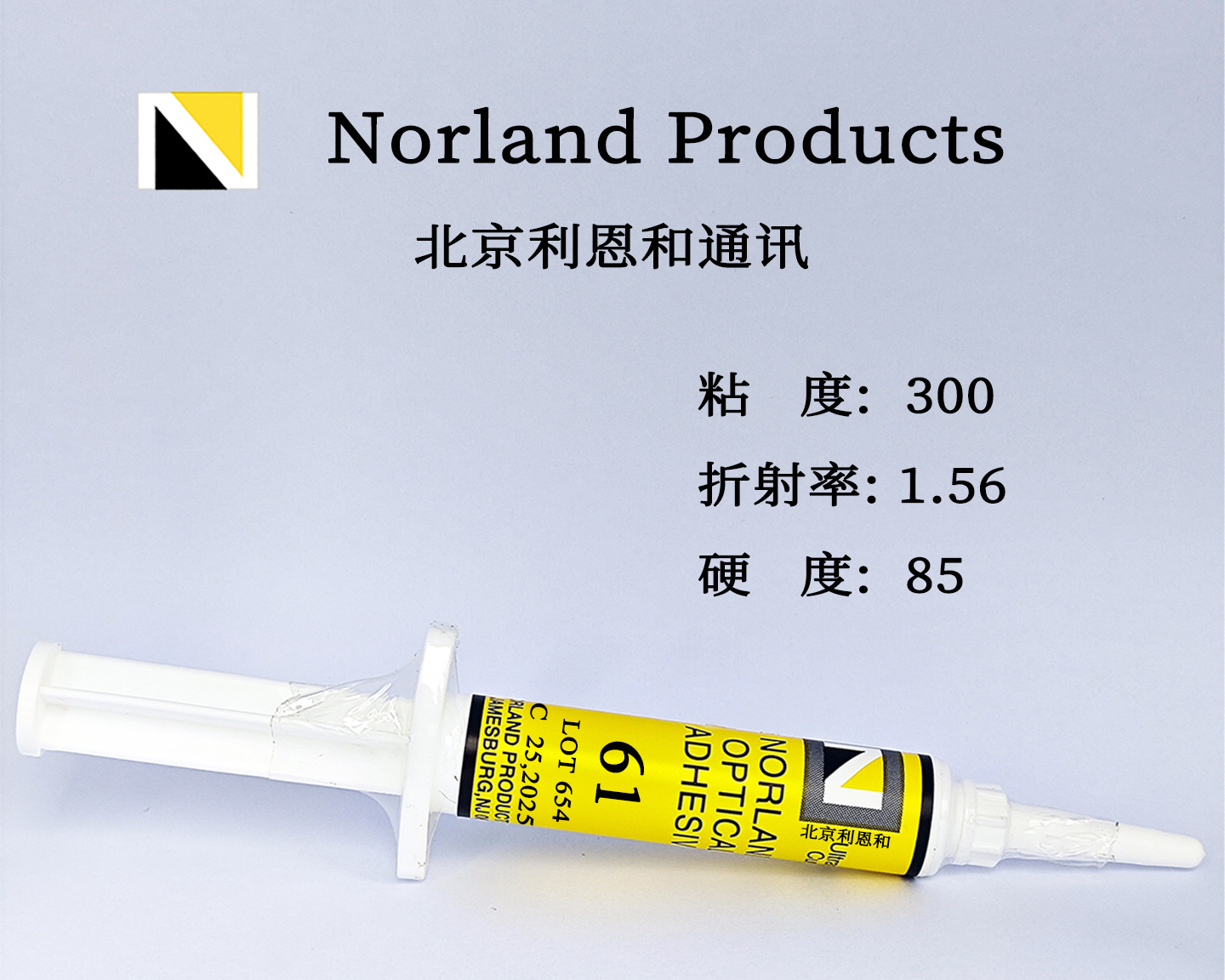
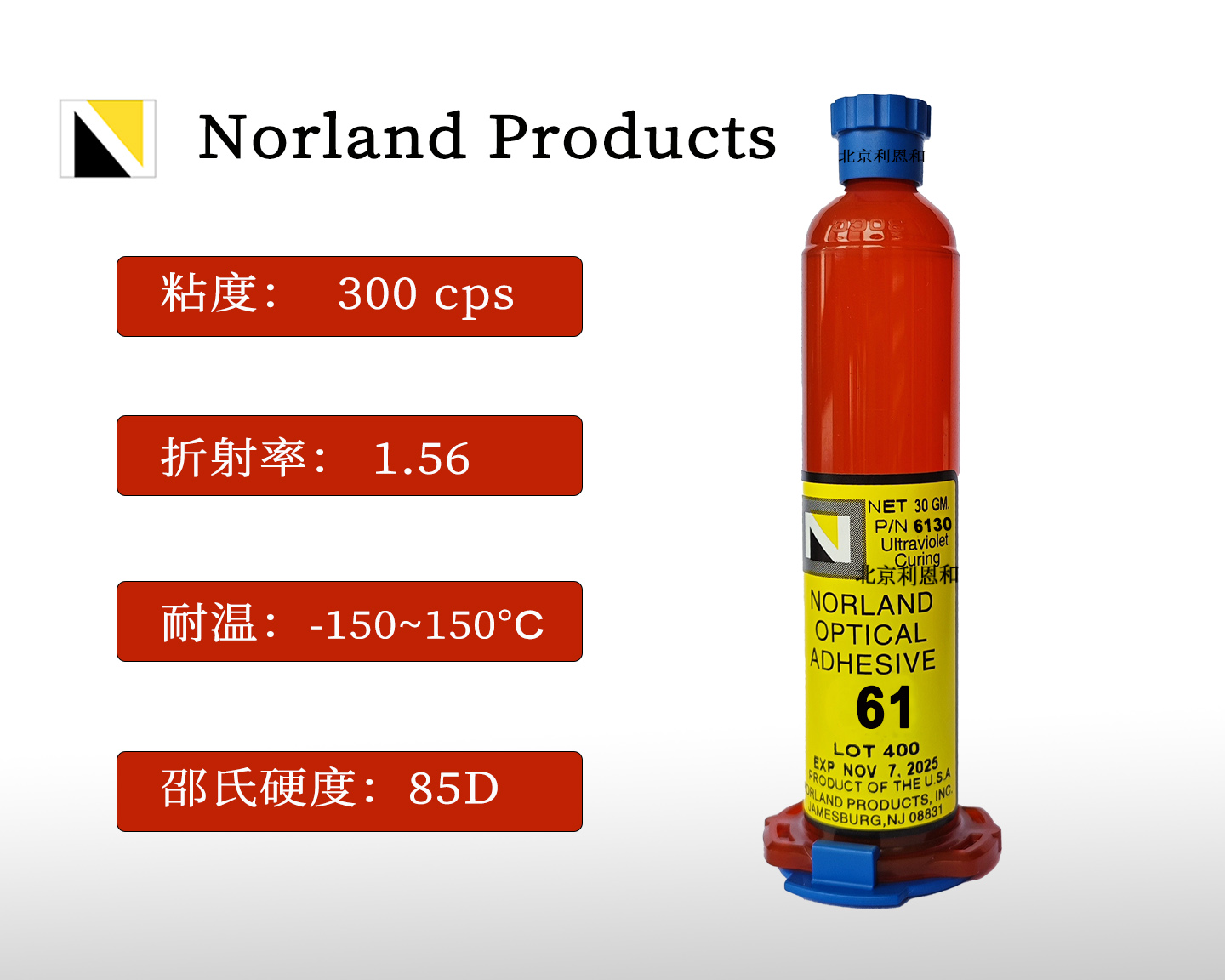
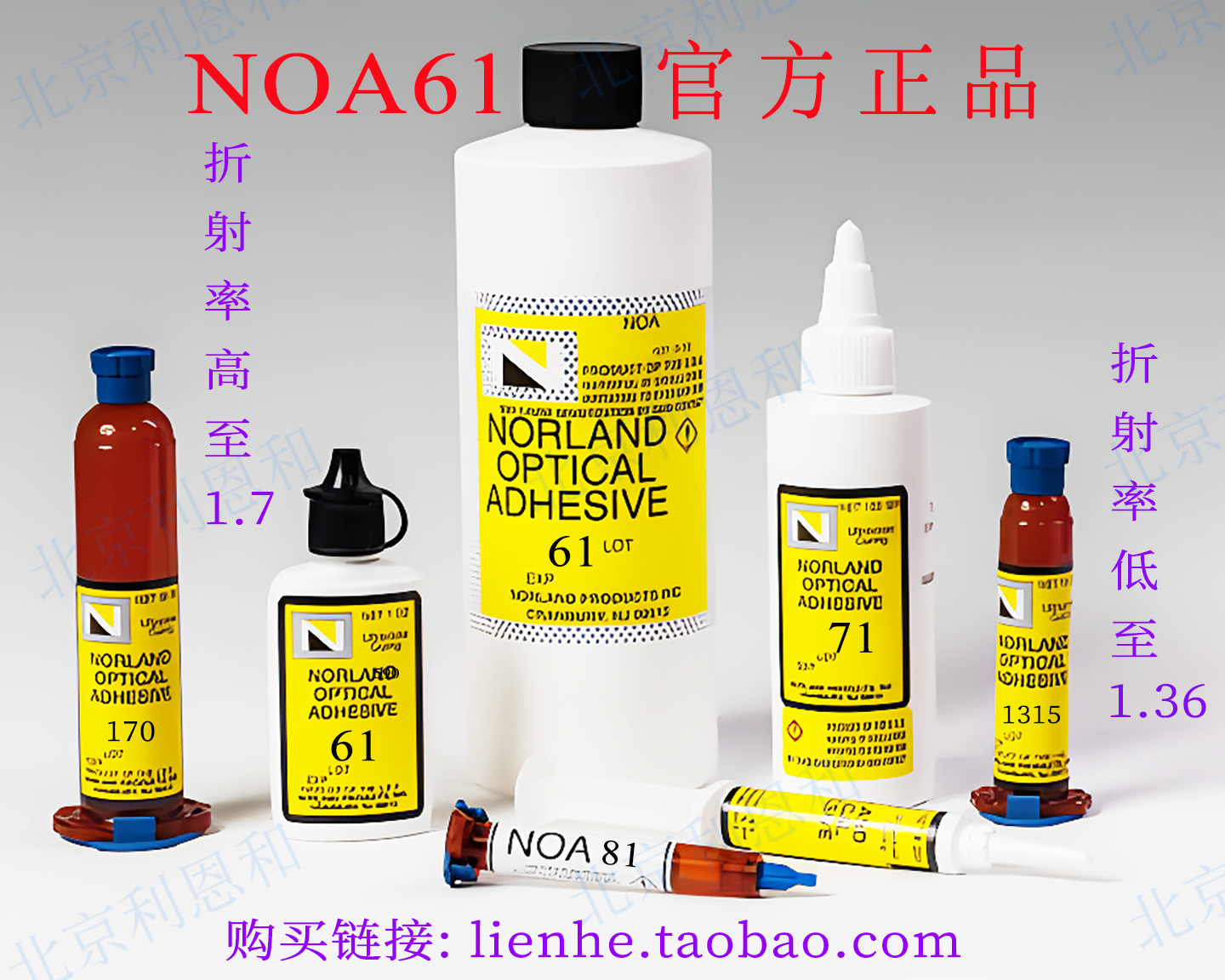
NOA61 Standard Packaging - 1-oz bottle, for laboratory and small-scale production
Norland UV-curing optical adhesive NOA61 is a clear, colorless liquid photopolymer that cures under UV. Because it is one-component and 100% solids, wherever the bond is exposed to UV it offers many advantages when bonding optical parts. Using NOA61 eliminates the premixing, drying or heat cure usually required by other optical bonding systems. It cures rapidly, depending on application thickness and the UV energy applied. NOA61 fully meets the US federal MIL-A-3920 standard for optical bonding materials. It is designed for glass surfaces, metals, glass fibers and glass-filled plastics, and is recommended for bonding optical elements such as lenses, prisms and mirrors, and for terminating or splicing optical fibers, in aerospace and industrial optics. NOA61 has good light transmission, low shrinkage and slight flexibility. It enables high-quality optical assemblies that retain long-term characteristics even as environmental conditions change. NOA61 cures under UV and is highly sensitive to 350-380 nm. The recommended energy for full cure is 3 J/cm2. Since there is no anaerobic reaction, air-exposed areas become non-tacky once exposed to sufficient UV. In many optical applications, curing is typically two-step. Step one: a short pre-cure, long enough to roughly position the bond but allow minor adjustment without upsetting alignment; after this pre-cure, a longer UV exposure achieves full cross-linking and solvent resistance. Pre-cure can be achieved with a 100-watt mercury lamp at 6 inches for 10 seconds. Where longer alignment time is needed, lower the intensity to extend exposure. Full cure can use a 100-watt mercury lamp for 5 to 10 minutes. Pre-curing lets users align and position parts quickly, and reduces the number of holding fixtures needed. After pre-cure, excess adhesive is easily cleaned with a damp cloth wetted with ethanol or acetone. Users can inspect parts, reject defects, and separate components with methylene chloride. To separate, the bond must be immersed in solvent; it usually separates overnight. Separation time depends on degree of cure and bond area. After full cure, NOA61 has good adhesion and solvent resistance, though its adhesion to glass is not yet at its best. After a week of aging, chemical bonds form between glass and adhesive to give the best bond. Good bond can also be reached by aging 12 hours at 50°C. When used for glass bonding, unaged NOA61 withstands -15°C to +60°C; after full aging, it withstands -150°C to +125°C.
Technical Specifications:
| Solids | 100% |
|---|---|
| Viscosity at 25°C | 300 cps |
| Refractive Index after Cure | 1.56 |
| Elongation | 38% |
| Modulus (psi) | 150,000 |
| Tensile Strength (psi) | 3,000 |
| Hardness - Shore D | 85 |
Light Transmission:

Storage Conditions:
Store in the original container, away from light, at a cool temperature (5-22°C) for up to 6 months. If refrigerated, allow the adhesive to warm to room temperature before use. When handling this material, use caution and first read the Safety Data Sheet, along with related product information, e.g., for alcohol, acetone or methylene chloride. Avoid prolonged skin contact; wash affected areas thoroughly with soap and water. If adhesive splashes into the eyes, rinse promptly with water for 15 minutes, and seek medical attention. Use in a well-ventilated area; otherwise, an organic-vapor respirator meeting NIOSH requirements is recommended.
NOA61 UV Adhesive Application Examples:
Memo:
2026.8.26: A customer asked about the Poisson's ratio of NOA61. Since this question has come up several times, we post the answer here:The Poisson's ratio of NOA61 is 0.43.
Other NOA adhesives, such as NOA83H and NOA84, have a Poisson's ratio similar to NOA61, around 0.43.