Product Description:
- An adhesive for plastic surfaces; it also bonds well to glass and metal, and can bond mixtures of all three materials
- Suited to manufacturing passive fiber-optic devices and to liquid-crystal display applications
- Suited to fiber coating and fixing, e.g., in the laser industry
- Suited to polarization-maintaining fiber applications, where it controls the extinction ratio well
- Suited to fixing small optical elements such as micro-prisms
- After aging, withstands -80 to 90°C; as a film or coating, withstands up to 125°C
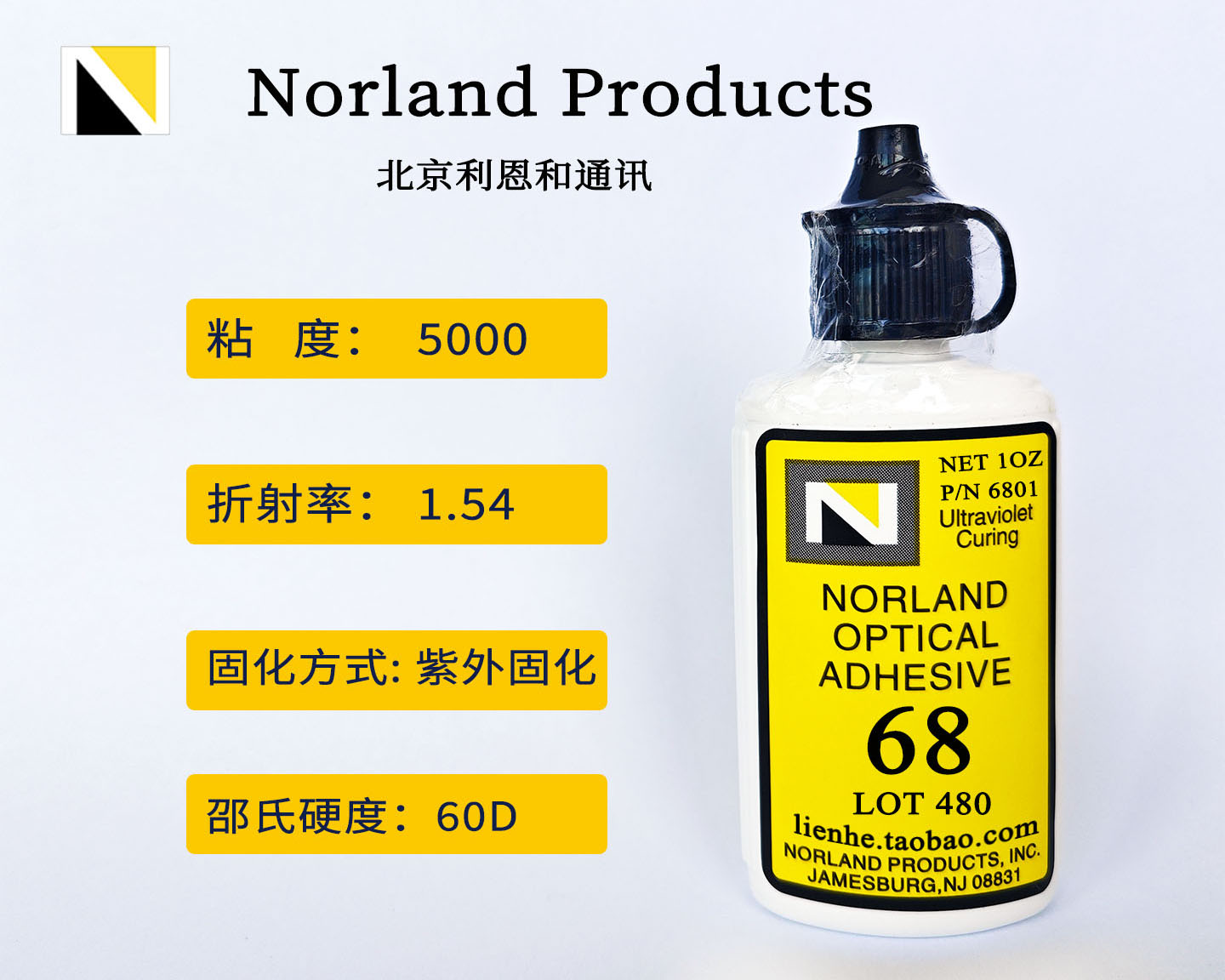
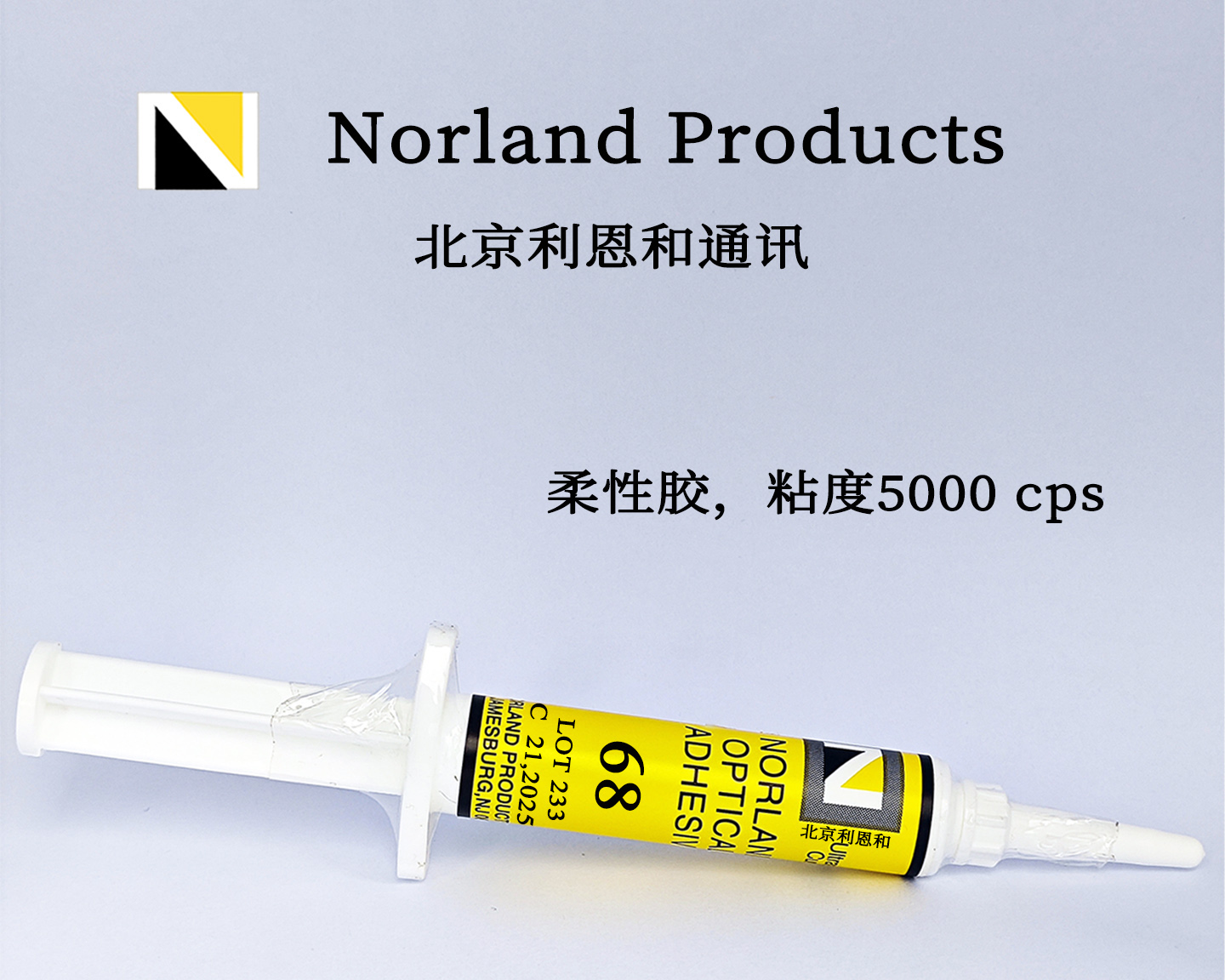
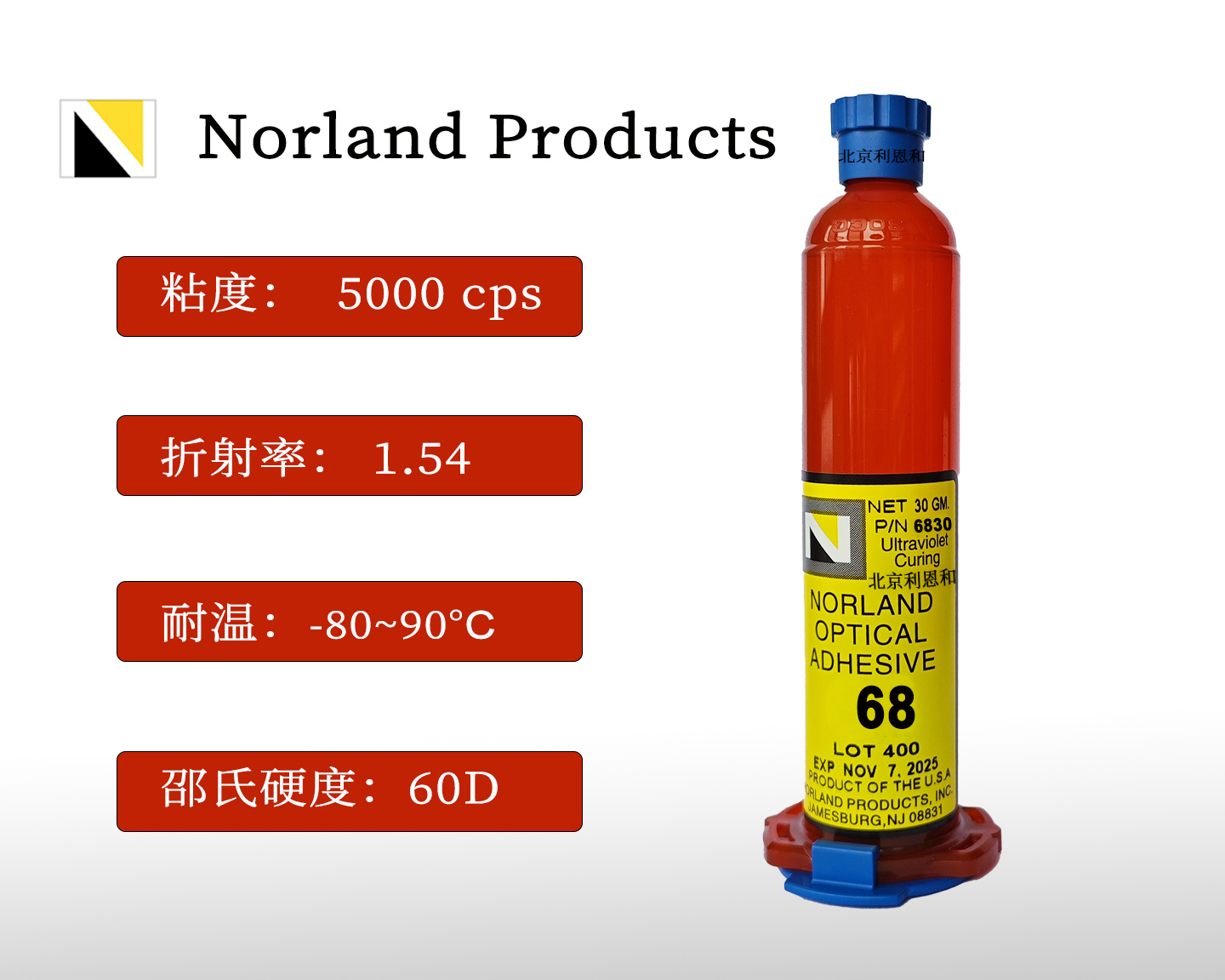
NOA68 Standard Packaging - 1-oz bottle, for laboratory and small-scale production
Norland NOA68 is a clear, colorless liquid photopolymer that cures under UV. It is
one-component and 100%
solids, and offers many advantages for bonding optical materials wherever the bond
line is exposed to light. The product is USP Class VI biocompatibility
certified.
Using NOA68 requires no premixing, drying or heat cure, unlike other optical bonding
systems. It cures very rapidly; cure time depends on the bond thickness and the UV
energy applied.
NOA68 bonds a wide range of plastics more effectively, such as acrylic,
polycarbonate and cellulose acetate butyrate. Besides plastics, it also bonds well
to glass and metal, and can bond any combination of plastic, glass and metal.
Typical applications of NOA68 include bonding composite plastic lenses, laminating
polarizing films between glass
/ plastic substrates, assembling plastic lenses to metal / plastic frames, and
bonding cover glass.
The recommended exposure energy for full cure is 4.5 J/cm2 of long-wave UV; the
material absorbs most strongly at 350-380
nm. Most glass and many transparent plastics transmit this band. Note that some
transparent plastics contain UV absorbers, which attenuate or block UV, slowing cure
or even preventing it. When designing a bond, ensure at least one substrate
transmits this UV band so the adhesive cures properly. Suitable light sources
include sunlight, mercury lamps and fluorescent black lights.
After full cure, NOA68 has excellent bond strength and solvent resistance, though
its adhesion is not yet at its best. After about 1
week of natural aging, chemical bonds form between the adhesive and glass surface,
reaching the optimum bond. The same optimum can be reached by aging 12 hours at
50°C.
After aging, glass bonds withstand -80°C to 90°C; unaged glass-plastic bonds
withstand -15°C to 60°C.
In some applications, when used as a film or coating, the adhesive withstands up to
125°C, depending on actual conditions.
Bonds can be separated with chlorinated solvents such as methylene chloride. Immerse
the bond in solvent; if only pre-cured, it usually separates overnight. Depending on
the degree of cure and bond area, soaking time may need to be longer. Note:
methylene chloride attacks many plastics, so use with caution.
Technical Specifications:
| Solids | 100% |
|---|---|
| Viscosity at 25°C | 5000 cps |
| Refractive Index after Cure | 1.54 |
| Elongation | 80% |
| Modulus (psi) | 20,000 |
| Tensile Strength (psi) | 2500 |
| Hardness - Shore D | 60 |
Light Transmission:

Storage Conditions:
Store in the original container, away from light, at a cool temperature (5-22°C) for up to 6 months. If refrigerated, allow the adhesive to warm to room temperature before use. When handling this material, use caution and first read the Safety Data Sheet, along with related product information, e.g., for alcohol, acetone or methylene chloride. Avoid prolonged skin contact; wash affected areas thoroughly with soap and water. If adhesive splashes into the eyes, rinse promptly with water for 15 minutes, and seek medical attention. Use in a well-ventilated area; otherwise, an organic-vapor respirator meeting NIOSH requirements is recommended.